
15 August 2026
What Freedom Actually Looks Like at Home
Every August 15th, somewhere in most Indian homes, there is a version of the same small ceremony - a flag folded a particular way, brought out of a drawer it lives in the other 364 days of the year, hoisted a little self-consciously in a courtyard or a balcony or a housing society compound. A few lines of a song most of us only half remember. A child in a school uniform reciting something they memorised the night before. Someone, usually an elder, watching all of it a little more closely than everyone else in the room.
That last detail is the one I keep coming back to. Because the rest of us are marking a date. They are remembering an actual morning.
School taught freedom as a fact with a year attached to it - 1947, a map redrawn, a flag raised for the first time. True, and also strangely weightless, the way anything taught before you are old enough to understand its cost tends to stay weightless. It took me a long time to realise that freedom, the way it is actually lived rather than taught, is not really about that morning at all. It is about every ordinary decision made possible afterward that nobody in that generation could have made before it.
A grandmother who chose which city to move to instead of being told. A father who picked a profession his own father never had the option to consider. A daughter, a few decades later, starting a business under her own name, on her own terms, answerable to no one for the shape of it. None of these moments have a date attached to them the way independence does. None of them get a flag. But every one of them is what independence was actually for - not the ceremony, but the ordinary freedom to choose, that got handed down, quietly, generation after generation, until it started to feel unremarkable. Until it started to feel like it was simply always true.
It was not always true. That is the part that is easy to forget precisely because the freedom worked - because it was passed down completely enough that the people who inherited it never had to think about its absence.
The generation that actually remembers the absence is thinning every year. Fewer people left who can tell you, first-hand, not from a textbook, what the morning of August 15th, 1947 actually felt like in their own house. And when that specific memory goes, what is lost is not the historical fact - that stays in the books, safe enough. What is lost is the feeling of it, the version that only ever lived in one particular person's telling, in their specific voice, with their specific pauses. That version does not get archived anywhere unless someone in the family decides, deliberately, to hold onto it.
This is, I think, the quiet, unglamorous work Independence Day is actually asking of us underneath the flag and the song - not just to celebrate that the freedom exists, but to notice who in your own family is still carrying the memory of what it cost, while they are still here to carry it. A grandparent's account of that year. A parent's account of what they were able to do that their own parents could not. These are not small stories. They are the actual mechanism by which freedom gets renewed every generation instead of just assumed.
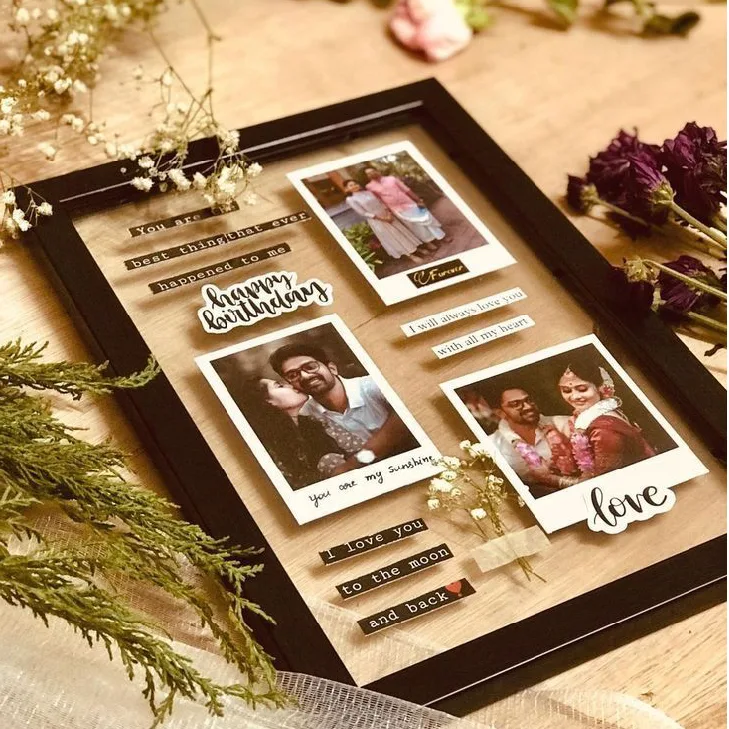
A family photograph does something similar, in a smaller way. Not the posed, occasion-only photo everyone takes and few people look at again, but the one that quietly holds three generations in a single frame - the freedom fighter or the ordinary survivor of that era next to the grandchild who has never known anything but the freedom they made possible. Printed properly, framed properly, kept somewhere it is actually seen rather than boxed away, that photograph becomes a small, specific monument to something the flag can only represent in the abstract.
If you are looking for a way to mark this Independence Day as something more than a holiday, that is where I would start - not with anything patriotic-themed in the decorative sense, but with an actual conversation, recorded or simply remembered properly, and a photograph that puts it somewhere permanent. A layered photo frame holding a grandparent alongside the family that came after them says more than any tricolour motif could. A framed portrait of the person in your family who actually remembers that era, given to them directly, tells them the story mattered enough to keep.
If your workplace is marking the day with something for the team - and many Vadodara offices do, a small gesture on August 15th has become its own quiet tradition - the same principle holds at a smaller scale. A named mug or a desk card holder with your company's mark on it is a small, real way of saying this year, this team, this specific group of people, mattered enough to acknowledge by name rather than a generic card. For anything at scale, our corporate gifting guide covers how to plan that properly.
However you mark it, the actual point of the day survives best in specific things - a story someone tells you once and you choose to remember, a photograph that keeps three generations in the same frame, a small gesture that names the particular people it is for. The flag captures what happened at a national scale. Everything smaller than that is still yours to keep.
Ready to personalise your own gift?
Shop Now